Wednesday, November 13, 2013

Touch Me Not but if you don't...

The TOUCH ME NOT plant with the beautiful orange-yellow flowers is found near bodies of water--it likes wet feet. Its an interesting plant--fun to play with and a powerful medicinal plant.


The green seed pods (long narrow and fat when ripe) explode when you touch them. I can spend hours lightly touching the ripe pods just to see them explode sending their bright green seeds in all directions.

The leaves are strong medicine for the itchiness of bites and stings. I usually grab a few leaves when I accidentally brush against STINGING NETTLES and smear the leaves all over the area that stings. Conveniently, at camp, they grow right next to each other. I also have been known to gather the leaves and puree them in a blender, put them in a baggie and then freeze them. Between the cold and the touch me not leaves, it is very soothing. Although when I was doing research, Wikipedia says "although controlled studies have not shown efficacy for this purpose" which I believe means that it doesn't work. You can try it if you get a chance--even if it doesn't work, it won't hurt you. 
    
For those of you who like the Latin name--Impatiens capensis! It is also known as Jewelweed because when the leaves are held underwater, they sparkle in the sunlight.

For more information on House In The Wood go to www.houseinthewood.com
All rights reserved 2013 by Valerie J Wright

Wednesday, November 6, 2013

Wild Edible Plants at House In The Wood

This was a lesson we did with the recent Rowe Elementary School 5th/6th graders at House In The Wood. We have a few wild edibles that are ready in the Fall like rose hips, grapes, hickory nuts and elderberries. We also have some that are ready in the Spring and Summer like raspberries, blackberries, chamomile, and various greens like lambs quarter. We also have various mushrooms at camp that are edible like the giant puffball.
Elderberries make jam and fruit wine.
 Elderberries are found on a bush. During the summer the bush has tiny white flowers. It takes a lot of elderberries to make either jam or wine as they are very tiny. they don't taste very good until they have been processed into something else like jam or wine--they need the sugar.
Wild grapes grow on vines over trees and bushes.
Wild Grapes can be eaten off the vine--they taste pretty good--but there is a large seed and very little grape. Suck off the grape meat and spit out the seed. You must be careful when harvesting grapes as they grow all over our Buckthorn trees and the berries look similar. One will make a tasty jam and the other will give you a bad case of diarrhea!
Rose hips from the rose bush.
The fruit of the rose known as a "Rose Hip" is often found in commercial herbal teas and it is a good source of vitamin C. I have only seen them made into a tea. When I taste them, they taste a little like citrus but they are mostly seed. I think that if they were just boiled in tea water with a little honey they would taste just fine. I will try it late this week.
Puff Balls located in the forest near the Bird's Nest.
Giant Puff Balls are edible. Slice them and saute them in a pan full of garlic and butter and you have a pretty tasty treat. There is NO other mushroom that looks anything like them so it is fairly safe to harvest and eat them. We did not do it because by the time we had a moment to harvest them, they were brown and ready to produce spores--no longer edible.

For more information on House In The Wood go to www.houseinthewood.com
All rights reserved 2013 by Valerie J Wright

Saturday, November 2, 2013

And the Seasons, they go Round and Round--its Fall Again.

Hummingbird visits the office feeder for a sip.
WOW...time really does fly! My last post was Spring and now it is late Fall.
...the HUMMINGBIRDS have already left after stoking up for the long flight further south of the United States,
...the BATS have already left for their warm caves (55 degrees year around),
...the WOODCHUCKS are already in their burrows for the winter, fat from a summer of eating well,
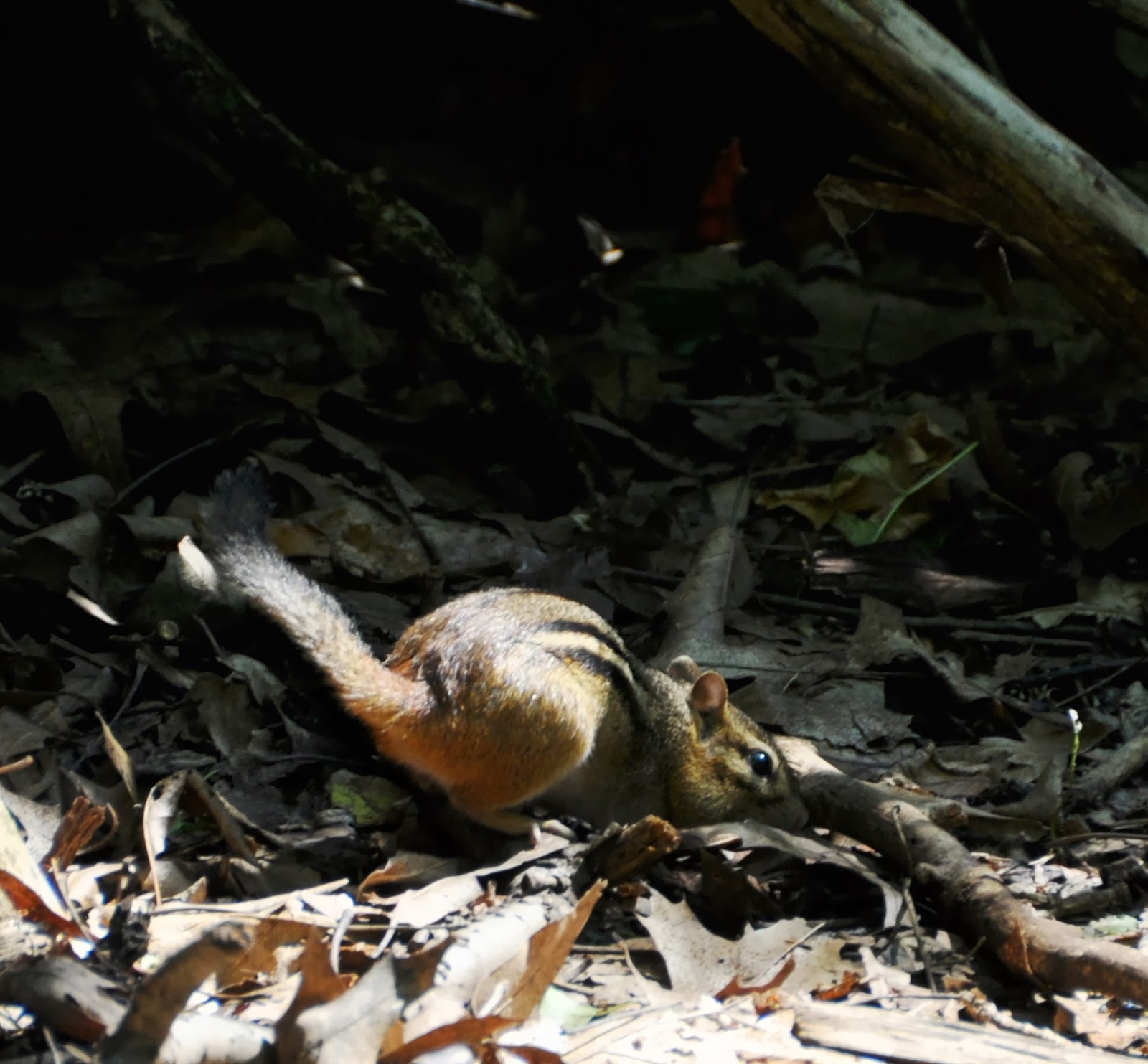
This Chipmunk is looking for nuts to take back to his burrow.

...the CHIPMUNKS have finished scampering around for nuts and we haven't seen them for the last few weeks so they must be snug in their underground burrows for the long winter, How do I know it will be a long winter? See below for information about the WOOLLY BEAR.
...the AMERICAN COOTS are gathering on the lake for the last leg of their journey to more southern states like Kentucky or even as far south as Florida,
...the RED WINGED BLACKBIRDS have left, but wait, after almost a month of not seeing or hearing them, I just heard them again. This must be a small group resting here on our lake from their trip starting further north.
A CONFUSED Woolly Bear caterpillar!
...this WOOLLY BEAR caterpillar is confused! Most woolly bear caterpillars have a brown stripe in the middle with two black stripes on each end. Folklore claims that the brown stripe is a predictor of the winter weather. A wide brown stripe means a mild winter and a thin brown stripe means a hard winter. I am not sure what THIS caterpillar is forecasting.


Looking northeast across the bay at House In The Wood.
 ...the trees are blazing with the bright colors of fall,
 ...the acorns and hickory nuts have fallen,
 ...the plants have spread their seeds,
 ...and the leaves are drifting down with every breath of wind.


For more information on House In The Wood go to www.houseinthewood.com
All rights reserved 2013 by Valerie J Wright


Sunday, March 17, 2013

Still Winter Here

I saw this herd of deer feeding in last year's corn field near House In The Wood.

On the other side of the hill were a few Sandhill Cranes just back from the south. On the same hill was the perennial sign of Spring--the Robin!

It is coming!


For more information on House In The Wood please go to our website at www.houseinthewood.com

We are operated by


all rights reserved 2013 Valerie J Wright

Monday, December 24, 2012

Nature Paparazzi-Blue Jay at the Feeder

I took this series of shots of one of the Blue Jays at my feeder. Every time I put out whole peanuts, I get a lot of Blue Jays. This is a common songbird at House In The Wood and is familiar to many people, with its perky crest; blue, white, and black plumage; and noisy calls. Blue Jays are known for their intelligence and complex social systems with tight family bonds.

Backyard Tip:

Blue Jays prefer tray feeders or hopper feeders on a post rather than hanging feeder, and they prefer peanuts, sunflower seeds and suet. Planting oak trees (House In The Wood is mostly oak trees) will make acorns available for Jays in the future. Blue Jays often take drinks from birdbaths.


Find This Bird:

Blue Jays are most often detected by their noisy calls--I think of it as a "rusty pump handle". You can recognize them by their steady flight, rounded wings, long tail and white underside.


Kool Fact:

The pigment in Blue Jay feathers is melanin, which is brown. The blue color is caused by scattering light through modified cells on the surface of the feather barbs. 


Another Kool Fact:

Their fondness of acorns is credited with helping spread oak trees after the last glacial period. They have an uncanny knack for picking weevil-free acorns to bury. In fact, birds in one study cached 3,000-5,000 acorns in ONE Autumn.


Information from my favorite birding website-ALL ABOUT BIRDS 
from the Cornell Lab of Ornithology:
http://www.allaboutbirds.org/guide/Blue_Jay/lifehistory
I just ordered a FREE calendar on the website!

For more information on House In The Wood please go to our website at www.houseinthewood.com

We are operated by


all rights reserved 2012 Valerie J Wright


Friday, November 30, 2012

Getting Ready for Winter-Our Beavers

I was walking along the trail yesterday and  I came across this...


 And then I came across this...
The Beaver Lodge (actually it is a bank burrow)  is in the foreground
and their food branches are frozen in the lake ice.
Our beaver has added to his lodge. He put fresh mud on the top and added a few more branches to the structure. He also gathered a bunch of branches at the entrance to eat during the winter. It has only been about 5 days since the lake froze in the bay. In the fall, beavers cache (store) branches and logs in the water, near a lodge or bank burrow so it is easy to get at in the winter. Beavers will go ashore in the winter as long as they can break through the ice at the pond's edge. More information about beavers on my favorite nature site EEK!

 One of my fisherman says that he has seen a total of 6 beavers! And one is the size of a medium sized dog! He said that they are very busy on the "point" chewing down the Vicki Martinez memorial Willow tree and taking it away.

For more information on House In The Wood please go to our website at www.houseinthewood.com
We are operated by


all rights reserved 2012 Valerie J Wright

Friday, November 2, 2012

Nature Stories--A Branch

We notice a scar on a person's face and, if they are willing, they tell us the fascinating story behind it. Nature cannot tell us its story. We collect and read the signs left behind and write the story ourselves. 
Picture taken in Wyalusing State Park near Prairie Du Chein, Wisconsin
I was walking the Sentinel Ridge Trail when I saw this branch. Look at it. It has had a rich life. 

Note the burned area in the upper left. I checked out the other trees nearby. There was more evidence of a fire on the base of nearby trees. This branch was part of a big fire that spread over a considerable distance. So what was the story of the fire? The fire could have started naturally with a lightning strike. Or it could have also been man-made. Was it an accidental fire started by a careless cigarette or match? Or was it started by the Parks Department as part of a forest management program? 

Most mature trees can withstand a fire on the very bottom of their trunk. This is a fire that doesn't have enough fuel on the ground to burn higher than a foot. It is natural for the forest to have fires every few years. Think of it as Nature's Housekeeper. When people moved into the area however, they put out the fires to save their homes and crops. So detritus from the trees that would normally have been burned away every few years accumulated. Eventually there was so much fuel lying on the ground, it made unplanned fires almost impossible to control once they started.

You can tell that this tree branch has fallen a long while ago as it is bare of bark. The healthy portion of bright green moss on top means it has also remained undisturbed for quite awhile as well. The wood is soft, dry and crumbles in your hand when you touch it so it is in advanced stages of decay. It has to be at least 40 years old and has probably laid in this very spot for another 10 years. 

It was home to an animal that can drill a nice round hole (see middle of the picture) probably a woodpecker. It is impossible to make a nice round hole in decaying wood so the tree was definitely alive when it hosted the animal living in the hole. As it decayed later in its life, other animals moved in like wood-eating insects or insects looking for a place to lay their eggs. This created a wonderful feast that encouraged other animals to tear into the soften wood to find eggs, grubs or insects to eat (see holes bottom center). You can tell they weren't interested in a home because the holes are very shallow and rough as though sharp claws or beaks tore into the wood. 

More information on Fires and Fire Safety from "Smokey the Bear"


For more information on House In The Wood please go to our website at www.houseinthewood.com
We are operated by


all rights reserved 2012 Valerie J Wright